The libre way to do open science
2026-04-10
Thank you OSCU for inviting me to talk here today!
I wrote my thesis on solar photoconversion with ZnO quantum dots but ended up realizing I am more interested in how to make the scientific workflow more reproducible, and today I work as a research data advisor at KTH.
Find me at http://solarchemist.se
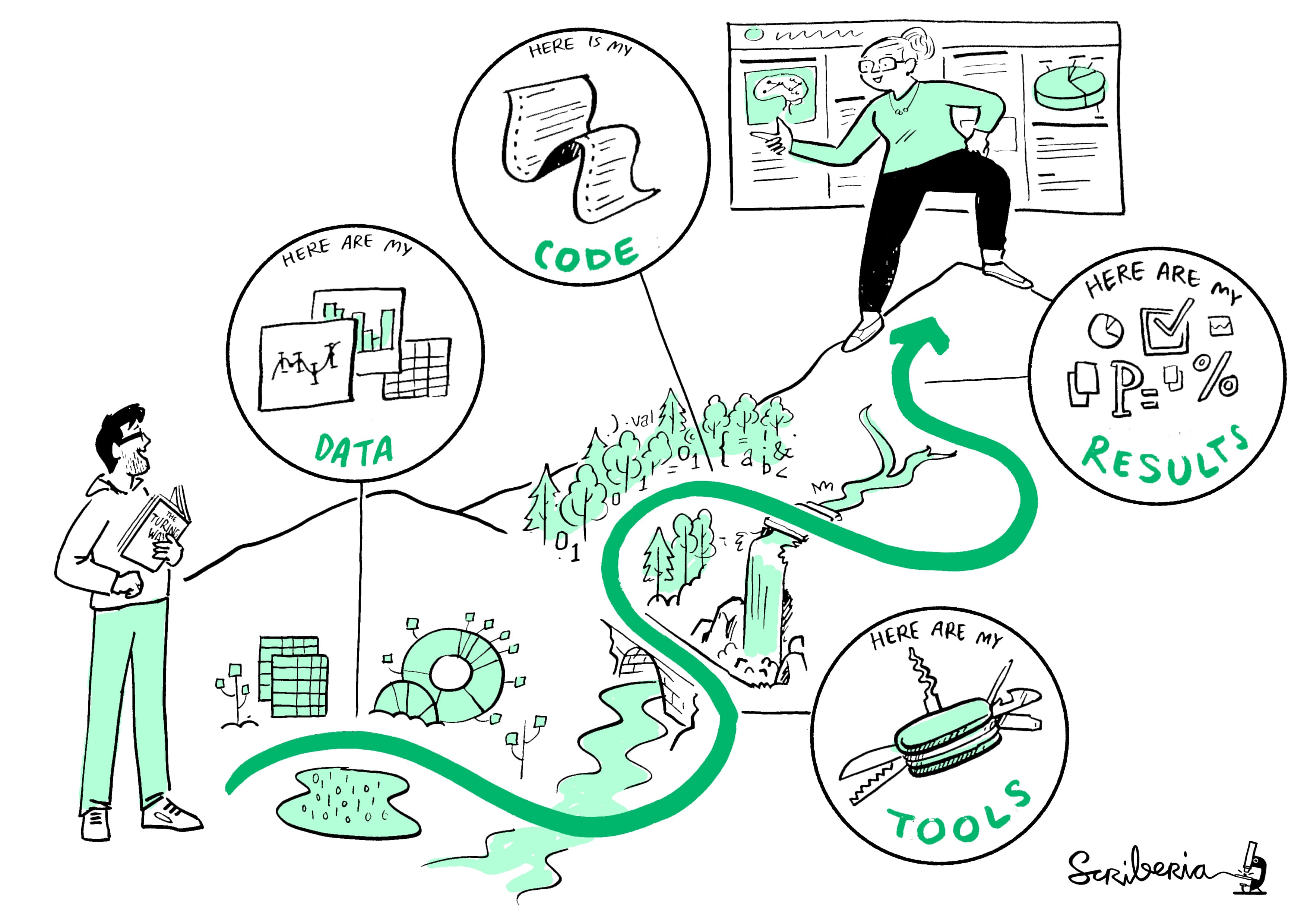
https://book.the-turing-way.org/reproducible-research/reproducible-research
Illustration courtesy of https://book.the-turing-way.org/reproducible-research/reproducible-research
This talk
Let’s ponder together to which extent you are able to use libre software and libre infrastructure today as a researcher. I will give lots of helpful examples, and also touch on how to share your own digital research artefacts (code, software, data) using free and libre services.
The aim is to do open science and contribute reproducible research!
Sidebar: These slides
Sources for claims or quotes are given towards the end of each slide as hyperlinks (they’re clickable if you open these slides in your browser, note the URL in the slide footer).
I often also include hyperlinks to related or other supporting work on the slide, to facilitate exploration and serendipitous discovery :-)
What is “open science”?
Let’s see what our university says:
The concept of ‘open science’ is used to describe openness, transparency and sustainability in all parts of the research process. With reference to scholarly publishing, this means open access to texts, research data and methods.
What is open science?
Generally defined as the trifecta of
- open source
- open data
- open standards
Note! Not just “show me” the code or data, but “let me do whatever I want with it”.
What is open science?
Let’s look at another way to describe open science:
Open science is about making research open, inclusive, and useful for everyone. The work involves different ways of making the processes that generate, evaluate, explore, and preserve scientific knowledge, practices, and perspectives more accessible.
https://openscience.se/en/what-is-open-science (SUHF and SND)
Benefits of reproducible research
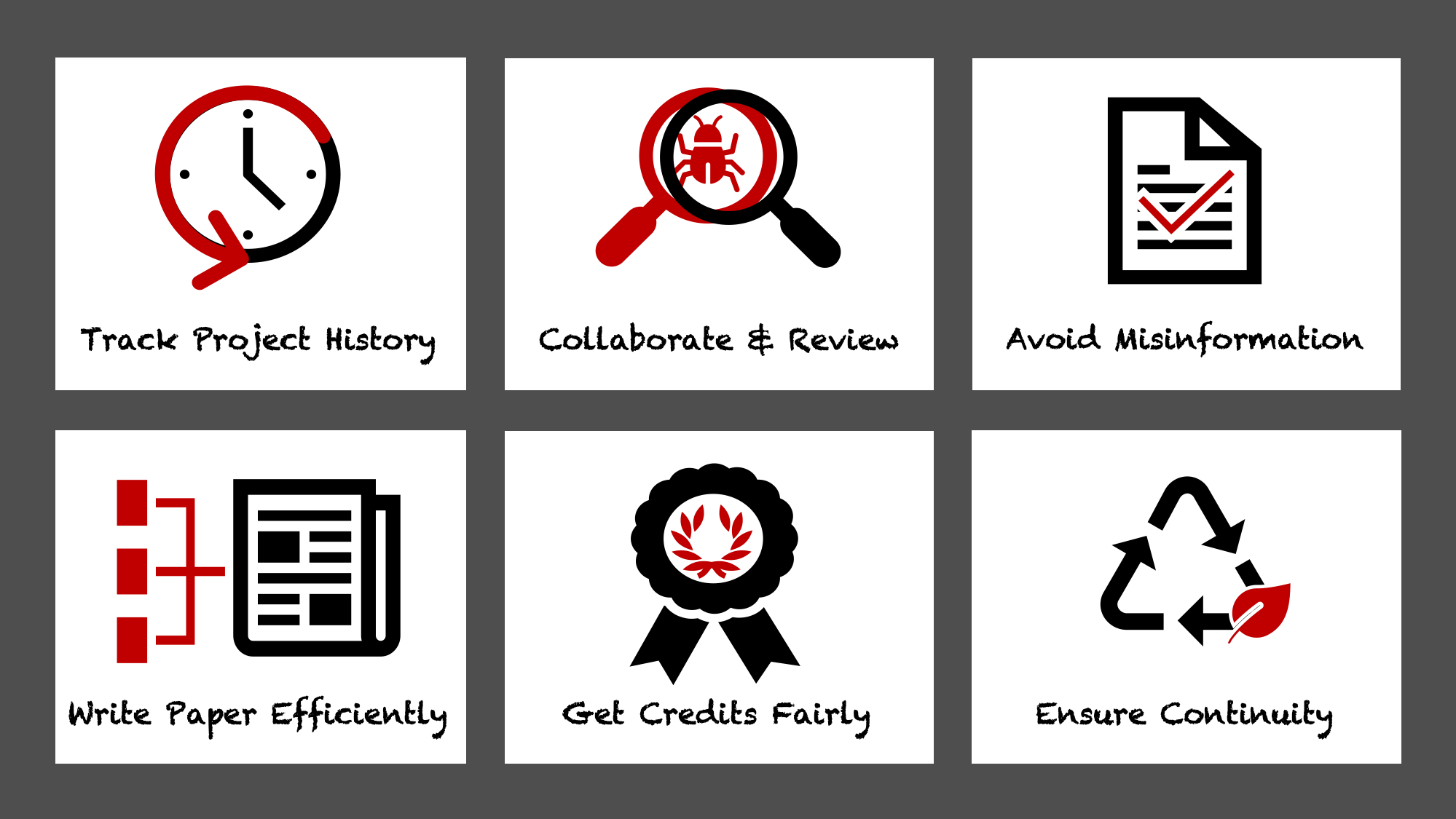
I would not consider these added advantages but rather integral for doing open science.
The idea is hardly new
An article about computational science in a scientific publication is not the scholarship itself, it is merely advertising of the scholarship. The actual scholarship is the complete software development environment and the complete set of instructions which generated the figures.
Stanford statisticians Jonathan Buckheit and David Donoho said this in 1995(!).
Sidebar: some constraints on this talk
I could easily talk for hours about the subject at hand :-)
- preregistration, not because I don’t think it’s important, but because other aspects of open science are more familiar to me
- all the interesting innovations going on with publishing (for example diamond open access, post-pub peer review, preregistration)
- what we should avoid doing (for example, the dangers of making AI part of the infrastructure of society)
My aim is to center this talk around what we, as researchers, should be doing. I will try to be as generalist as possible, but I hope you forgive me if my specialization (in materials chemistry) sometimes comes through.
A short video break
At this point I thought we could watch this short, awesome video “A reproducible workflow”, straight out of 2016:
Reproducibility in every step


If this feels like new ground for you, I can recommend CodeRefinery’s well-crafted web course material.
Steeves, V. (2017) “Reproducibility Librarianship,” Collaborative Librarianship, 9(2). https://digitalcommons.du.edu/collaborativelibrarianship/vol9/iss2/4
https://coderefinery.github.io/reproducible-research
https://book.the-turing-way.org/reproducible-research/overview/overview-barriers
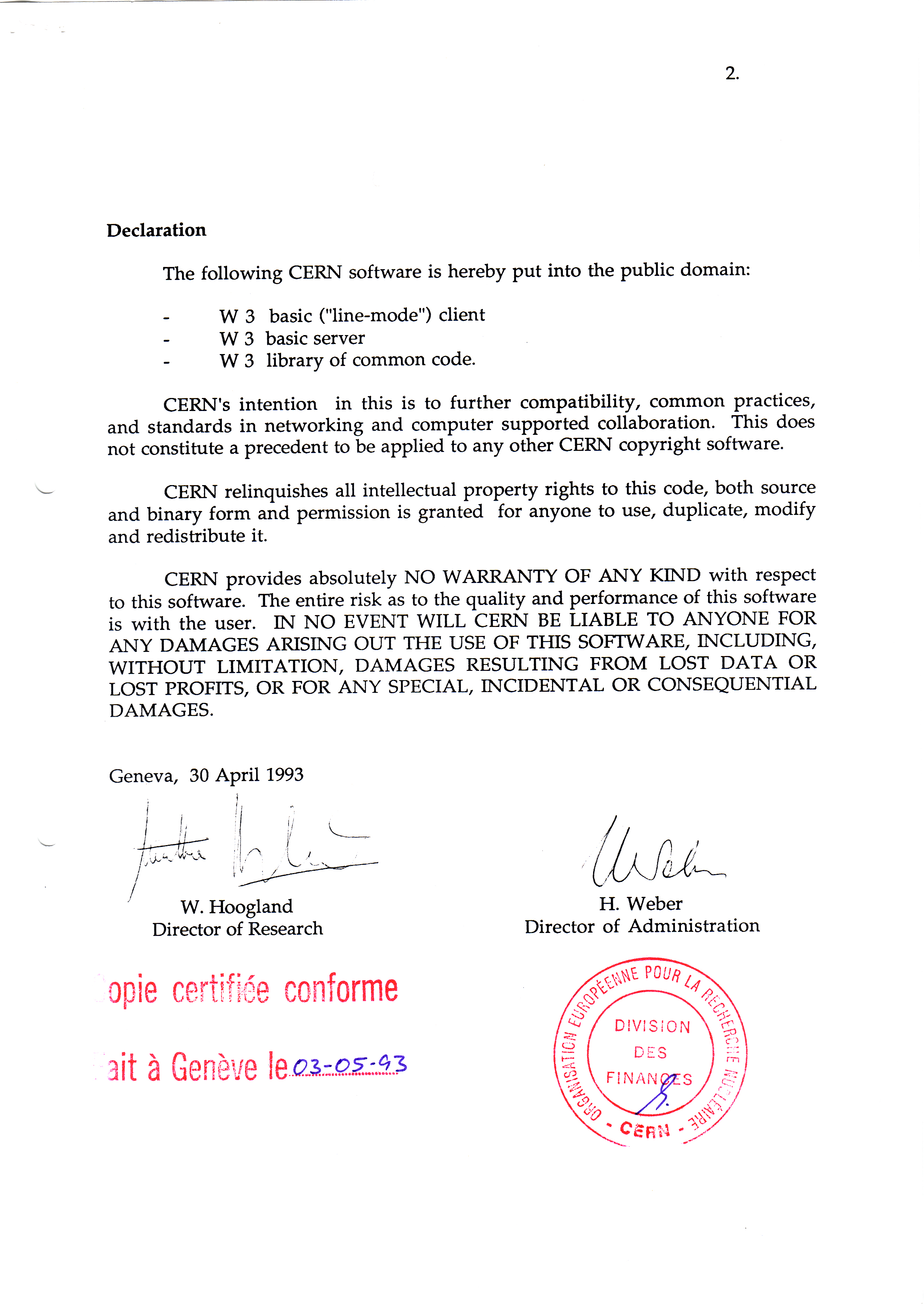
The ultimate enabler: the World Wide Web
Licensing and the term “libre”
The philosophy of copyleft licensing is as follows:
As a User (the Licensee) of the licensed software, you cannot redistribute the original or a derivative work with fewer rights than the ones you yourself received.
“Libre” means copyleft. “Open source” is a weaker licensing model.
The term FOSS is common to denote “open source” (usually software), but since it permits non-copyleft licenses (such as MIT), the witty PR dept of the hive-mind have minted FLOSS (free and libre open source software).
The license that applies to your work is your choice!
Libreate your workflow
Examples in the areas of:
- Social networking and literature discovery: Fediverse, RSS, hypothes.is, Zotero
- Writing: Markdown, LaTeX, pandoc
- Sharing data: Zenodo, researchdata.se, domain-specific or institutional repositories
- Sharing code, applications, dashboards: SciLifeLab Serve, Binder (Jupyter but also R)
Literature discovery and networking
- Zotero (of course!) but also consider Docear, Jabref
- The Fediverse
- Mastodon, but also Peertube, Pixelfed, and much more
- RSS is a web standard and very useful
- A tip: Fraidycat (browser plugin feed reader)
- Hypothes.is a web standard - “annotate anything on the web”
- The Fediverse
https://links.solarchemist.se/shaare/cgldhQ How to use RSS feeds
https://links.solarchemist.se/shaare/mQIwvQ Annotate the web
Fediverse
“A place to have conversations online without algorithms, AI, and ads getting in the way.”
Fediverse statistics as of Feb 2026:
19 175 active instances (Mastodon 66%)
15.8 million users, 5k new users in the last 24h
SUNET hosts a Mastodon instance: http://social.sunet.se
https://gts.sadauskas.id.au/@aj/statuses/01KHCQFQVEXJKWT7X2HEH5WW1H Explaining the Fediverse to someone who have not used it
https://blog.elenarossini.com/openness-transparency-and-reach-three-reasons-why-public-institutions-should-embrace-the-fediverse Openness, transparency and reach: three reasons why public institutions should embrace the Fediverse
https://links.solarchemist.se/shaare/7YEXBA Another intro to the Fediverse
https://libera.site/channel/fediverse?mid=bd62dda4-5d2d-4b29-a9cd-686a95d6022c
Writing
- LaTeX, over 30 years old but going strong
- Markdown, teenager that has proven its potential
- Pandoc, perhaps the only widely useful Haskell program ;-)
https://pandoc.org
https://links.solarchemist.se/shaare/FG_hsw Important tools for scientific writing: Markdown and pandoc
LaTeX
- TikZ and PGF packages (Tantau, 2010)
- siunitx package (Wright, 2008)
- subcaption package, also for subfigures (Sommerfeldt)
- cleveref package (Cubitt, 2018)
- booktabs package for publication-quality tables
- beamer LaTeX class for beautiful presentations
- biblatex package and the
biberprogram - glossaries and glossaries-extra packages and
bib2glsprogram - longtable package (Carlisle, 1993)
- chemfig package (Tellechea, 2010)
https://links.solarchemist.se/shaare/-oOmOA The LaTeX ecosystem from my limited point of view
https://git.solarchemist.se/latex/uuthesistemplate LuaLaTeX style used in my thesis
https://solarchemist.se/thesis Thesis as a reproducible manuscript
https://practicaltypography.com Butterick’s practical typography (for typography nerds)
Sharing data
Deposit your data on Zenodo (CERN), researchdata.se (SND), domain-specific or institutional repositories.
The Swedish Research Council’s view is that everybody should be given access to research data that are financed via public funds.
https://codeisscience.github.io/manifesto/manifesto.html
“Digging deeper into data citations: recognizing and rewarding data work”, DOI: 10.1093/reseval/rvag008
https://links.solarchemist.se/shaare/NGPZxw my linknote on CFF
https://snd.se/sv/nyheter/vetenskapsradet-publicerar-kriterier-och-vagledning-att-gora-data-fair VRs kriterier och vägledning för att göra data FAIR 2021
https://www.vr.se/uppdrag/oppen-vetenskap/oppen-tillgang-till-forskningsdata/stod-och-verktyg/tillgangliggorande-av-forskningsdata-och-fair-kriterier.html Tillgängliggörande av forskningsdata och FAIR-kriterier 2021
https://www.vr.se/uppdrag/oppen-vetenskap/oppen-tillgang-till-forskningsdata/rekommendationer-for-fair-och-oppna-forskningsdata.html VRs rekommendationer för FAIR och öppna forskningsdata 2022
https://www.fairsfair.eu Fostering FAIR Data Practices in Europe
Sharing code or software
Code is science!
First of all, give yourself a pat on the back for writing code instead of pointing-and-clicking your way through analysis or visualizations!
- Make it easier to claim credit and for your code to be cited properly by including
codemeta.jsonand/orCITATION.cff
Host your code yourself, or check if your university offers hosting, or consider
- Binder https://mybinder.org
- SciLifeLab Serve https://serve.scilifelab.se
https://blog.ouseful.info/2019/09/11/running-r-projects-in-mybinder-dockerfile-creation-with-holepunch Binder works with Python, R and RStudio too
https://blog.jupyter.org/binder-with-zenodo-af68ed6648a6 Even better, combine Binder with Zenodo
https://codemeta.github.io
https://citation-file-format.github.io
https://research-software-directory.org The Research Software Directory
https://fairsoftwarechecklist.net Self-assessment for FAIR research software, gives you a nice badge for your website!
Publishing
Perhaps you have heard about
- Rogue Scholar
- “Join your blog to make it FAIR”
- Rogue Scholar’s platform is built on Invenio, which gives them lots of brownie points in my book.
- “Join your blog to make it FAIR”
- SciPost
- uses an interesting potpourri of new ideas
- I like them simply because they give RSS feeds pride of place
Sometimes you have no choice, Big Tech is too entrenched!
Don’t despair, and learn modern techniques to cope :-)

Signing off!
- Right here in Uppsala you have the Linux User Group. They are a great resource, you should go to one of their hack meetups! Or follow them on Fediverse @ulug@social.linux.pizza
- Also only in Uppsala, Uppsala.social Mobilizon instance.
Thank you for listening!

https://public.solarchemist.se/slides/oscu26